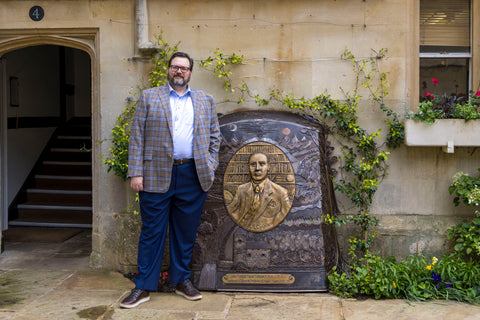
Last week John Green visited Salt Lake City for one of the final stops on his book tour for Hollywood, Ending. The West High School auditorium welcomed over a thousand readers eager to see one of their favorite authors for the arrival of his first novel in nine years.
John shared his gratitude and his love, acknowledging the “weird shared experience that we won’t be able to quite communicate to those outside the building.” He shared the insight that movie sets are the same way—a small group of people building something to share, but the experience that they create together is something that cannot be shared. This was one of the observations that became Hollywood, Ending. “Movies are these hundred people working on a cool private thing to make another thing and it really is magical,” John said.
The other half of his inspiration is the more difficult side of that same experience. He quoted another successful author who once told him “fame is the worst good thing that has ever happened to me.”
“I started this book thinking that I was writing about how celebrity culture and the machine commodify things like personality and privacy. Once, only celebrities shared their personal lives with the public. Now we all do it through social media. The last time I wrote a book, I wrote a lot about OCD. There was a real cost to that; I felt exposed and vulnerable, and more than a little scared. The next step was of course to write about movie stars, characters who turn traumatic human experience into movie tickets.”
He ended the introduction of the nights events with a Mr. Rogers quote:
“Mr. Rogers once said ‘Fame is a four-letter word,’ he paused for a long time before adding, ‘and like pain, or life, or love, what matters is what we do with it.’
“Art is not optional for humans. We made it before we had a caloric surplus or specialization of labor, and we will make it the entire time we are here. And it will be made by us, by humans.”
His final introductory note for Hollywood, Ending was that he wrote about love and longing and how we can get to where we are going.
Hollywood, Ending is John’s adult fiction debut, one part romance and one part a deep exploration of the price paid for fame. It's vulnerable, sweet, hopeful, and will break your heart in the way that only John Green can. He read the first few pages for the audience, as “you can’t have a book reading without actually doing the book reading.” If you haven’t heard him read it yet, he put the first chapter on YouTube (Content advisory for adult language and themes):
The Brandon and John Interview
Transcript has been lightly edited for clarity and flow.
Brandon: All right, so I’ve just got a few questions for John that I mulled over while I was reading the book. And you know, I’m a long-time fan and it’s John Green. Just some things I wanted to chat about. And the first one is “Are you okay?”
I'm starting to work in Hollywood. I’m only beginning and I’m like, oh, I recognize some of what is happening in the book. I recognize this or that, but the stuff I don't recognize is pretty horrifying. Are you okay?
John: You know, I am okay. I’ve been really blessed in Hollywood in a lot of ways. I’ve really liked a lot of the adaptations of my work, and I’m lucky to have adaptations at all.
It really is magical to be in a situation where so many people are orienting their love toward your work and to see places that only existed inside your imagination exist in real life is thrilling. And to hear talented actors say words that you wrote for them is thrilling.
All of that is wonderful. The machine does concern me some, not just for actors and not just for Hollywood, but for all of us. All of us are now engaged in this exchange, and it really does freak me out that we don’t have the line between the personal and the public that we used to have.
So a lot of this book is about Andy Warhol, the great artist who died in the late 1980s. Warhol was world famous. He was the most famous artist of his time. Nobody knew who his partners were during his life. Nobody knew that he took his mother to church every Sunday or that he was a devout Catholic. That would have been the freakiest thing about him in New York City in the 1980s.
So he had a private life, and that is a luxury that is really no longer afforded to most celebrities, including, on some level, even writers.
Brandon: I sometimes think about how little I knew about Robert Jordan’s life. All I knew was what was on the back of the book, and sometimes it lied because it told me the next book was coming out next month.
John: Thank God for you, right?
Brandon: This [question]’s a little more serious. I think the line there’s a lot of lines in this book. I mean, it’s a John Green book, but one of them that really stuck out to me is that you talked about making art that is or art that is about. And I really like that. Oscar Wilde famously said, “Art is useless.”
If it’s about something, then it’s not art, in his opinion. And yet it’s Oscar Wilde, so obviously he’s lying. My question for you is, do you make art that is or that is about?
John: That’s a difficult question. They prepare you for a lot in media training. They did not prepare me for that question. I make art that is about and I'm kind of unapologetic about it. In the novel I’m writing about this famous painting by Agnes Martin called With My Back to the World.
For the last fifty years of Agnes Martin’s life, she didn’t look at a newspaper. She didn’t know who the president was. She didn’t engage in that part of the world at all. And she would say, “I paint with my back to all of that.” And she was trying to paint innocence. She once put it this way: “I’m trying to paint the way it feels when you wake up in the morning and you feel happy for no reason.”
How do you paint that? We have metaphors that allow us to paint that, right? If you want to paint innocence, you might paint a lamb. But of course, a lamb isn’t innocence. How do you paint innocence itself? How do you paint joy itself?
And I do think as a writer, I’m really interested in trying to evoke those emotions themselves, evoke those deep feelings themselves, not exclusively through metaphor, but also through making someone believe in the characters and in the story so much that it feels real enough to them to evoke real feeling.
But I’m also writing about themes, and I guess that’s a little old-fashioned in some ways. Like it’s a little old-fashioned to try to want your work to be useful, but I do want my work to be useful in the lives of its readers. I do want it to be helpful to them. I do want it to make me feel less alone.
Because that in turn makes me feel less alone. And that’s part of what books did for me, especially when I was younger. And the other thing is that I always want—and this is very much a fashion brand—but I always want my books to be hopeful. I really believe that true stories are hopeful stories, and not all hopeful stories are true.
But all true stories are hopeful. And I really believe that.
Brandon: So that actually reminds me of a question for you about that. So we’re going to jump: One of the hallmarks of your style, which is something that I really like about it and which is something that I try to do also, is like, this book has some, some dark stuff in it.
John: Yeah. Not as dark as from your stuff, man.
Brandon: I see what you mean, but it’s darker in some ways, because yours is happening to people in this world. Real people. Part of the strength of fantasy is you can divorce some of that. You can take the real world away, and you can make the characters feel real. But the real world not being there makes it more endurable.
You are able to navigate positive hopefulness with some real darkness, some real serious health challenges, some people who maybe make some bad decisions and some things about life. How do you navigate that thread? Because I would call the John Green book a hopeful novel, and yet if you try to explain the plot of some of them, they are pretty dark.
John: Yeah. I just think that’s the truth. I think that’s the truth. I mean, before I was a writer, I was a book reviewer, and before I was a book reviewer, I was a chaplain at a children’s hospital, and it was the hardest work I’ve ever done, the most important work I’ll ever do.
Because real change in life happens one-on-one. It happens one person at a time, one teacher reaching one kid, one librarian giving a book to one kid. That’s the real change in life. And I felt like I was making that change when I was a chaplain. It was the hardest place. The worst things that you could imagine and worse happen there.
And as you say, it wasn’t a fantasy world. It was brutal. It was devastating. It was very hard for me to reconcile with a hopeful worldview. And yet at the same time, it was also many other things. It was one of the funniest places I’ve ever worked. The kids I worked with were hilarious. Often in very, very dark ways, in ways that I can’t repeat. But they were coping. And also it was a hopeful place, you know?
Hope is the correct response to consciousness, not because hope is always rewarded, but because hope is always justified, I think. And so in the hospital, I found that, as you know, all the reasons I came in with, with why bad things happen to good people were blown apart by being at the hospital, completely blown apart.
I couldn’t emerge from that thinking that everything happens for a reason, or that there’s a plan for everything. And some people can, and I admire them and don’t wish to criticize their worldview. But for me, I couldn’t. I had to emerge from that with a different kind of hope, a hope that could withstand what I saw as the reality of injustice and suffering. And I try to reflect that in my books.
Brandon: Now, going a slightly different direction: There’s a fantasy novel in this book and a fantasy novelist, and the fantasy novelist writes the screenplay. There are some comments about that. It’s a very big fantasy novel, one with a lot of worldbuilding. I wouldn’t call it a major theme in the book, but it keeps popping up and I keep reading this book and thinking “Huh, he selected me to interview him?” And all the movie people are always criticizing her for wanting to be very involved.
John: I was not thinking of you, I promise. I wanted to write about Valentina Leavitt because I often cast myself in different roles in my writing, and I cast myself in the role. Where I’ve been on the other side of the casting director’s table, where the actors say things like, “Why the hell is he here? Like he’s not choosing it. Is he? I hope he’s not casting the movie,” which, of course, I’m not.
You know, I do want to be involved and I want to have a seat at the table. And sometimes I feel like wanting to have a seat at the table is a little bit judged by some of my peers.
Brandon: I definitely felt that as well.
John: Yeah. I don’t know how to say it. Right. You know what I mean? Well, I mean, the audience does. That’s because a lot of authors are really bad at the movie business. So bad. And by the way, one of those authors is me.
I wrote a script for Paper Towns, my third novel. I wrote a screenplay adaptation of it, and it was so bad. However bad you think it was, it was worse.
Brandon: Was it your first screenplay?
John: It was my first, but even in measures of first screenplays, it was very bad. And one of the things I learned—and this is not an issue for you because you’re so brilliant with constructed beats and understanding structure and everything–is that in a screenplay you need many things to be happening. At the same time. You need every line of dialogue to accomplish multiple things. There’s such an economy about all of it that’s so hard to achieve. If, like me, you have no idea how to write like that, then you really need to be a more architectural writer than I am in order to succeed as a screenwriter.
I am one of those people who is both difficult and bad. So that’s worth remembering.
Brandon: I mean, you say this, but my first screenplay, I just put all the stuff in that I put into the novel, added 300 pages, and you want to know screenplays? I’m like, I haven’t gotten to the editing yet. I watched the heck out of it.
Yeah, it was really full. So, yeah.
John: You think you know how to write a screenplay because you write novels, you know? And in general, if you think you know how to write one thing, you don’t necessarily know how to write another. I tried to write a picture book once. It was called Booger McSnotrocket Saves the World, and I sent it to my agent.
She said, it’s not just that you shouldn’t publish this. You should also delete it. So that they dont find it when they come for your papers. Yeah, I’m sure this is a joke, but, this is not my list.
Brandon: One of the things that I don’t think the rest of the world knows about that is so fun for us who have both worked in New York and in Hollywood is New York’s editors and Hollywood’s, everyone lives in different worlds, right?
The difference is like there’s that aspect of New York, the call-it-like-you-see-it, and then there’s Hollywood where you never hear if they don’t like something. Like, the feedback is never, “I don’t like this.” It is instead, “Well, what if we did this, or what if that?”
Sometimes I would just get a page back from New York circled that says, “Do better.” That’s not terribly helpful either. But at least I know they didn’t like it.
I’ve had feedback in Hollywood where I could not tell if they liked the thing or not because I couldn’t parse it and they weren’t willing to tell me what they felt.
John: My actor friends often say that in Hollywood you never get rejected. You just see someone else on the movie poster and say, “Oh, I guess I didn’t get it. I guess that one went to Leo.”
Brandon: More serious question. This is something you talked about a little bit over at the podium: What do you think you personally gain and what do you personally give up by being on the public stage?
This is a very powerful theme of the book. I was curious about you, and things like your relationship with your brother, which is so public. Your mental health challenges are so public. I feel like you’re even more public than most of the movie stars that you would write about.
John: Yeah, because I make a video every Tuesday. But the weird thing is I really trust the people who watch those videos in a way I don’t trust the public public. And it’s hard to differentiate between those publics because sometimes, like when Hank got cancer, for instance, it was awful because even before we knew what kind of cancer it was, we knew that he was going to be starting chemotherapy almost immediately.
We knew his appearance was going to begin to change. And we were going to have to figure out what to do about it. It was only like ten or fifteen minutes after he got the news that we were on the phone and we were asking, “What are we going to do? What are we going to do functionally, and practically?”
He had a choice, right? He could either disappear from the internet for eight months while he received treatment, which would lead to a lot of speculation. Or he could talk about having cancer. And both those choices kind of sucked. In the end Hank did a very Hank Green thing and sort of science-communicated his way through cancer.
He dealt with it brilliantly, but at the time it was really, really hard. And it caused a lot of reflection for me about what parts of our lives are allowed to become public.
And so it’s a really difficult thing for me to navigate, to be honest with you. And I think about it a little differently than I used to. We’ve never talked about our kids. Y’all aren’t that interested in them anyway. They’re regular people, they’re children, they’re boring.
I do talk about other aspects of my life, and I feel conflicted about that because I gain a lot, as you say, I am given a lot. And part of what I’m given is that I feel less alone. I used to feel so deeply ashamed of having OCD.
I used to feel so controlled by it, and so much like this was a horrible thing that no one could know about. And now I feel very empowered when I talk about my OCD. I feel like it’s something that I’ve integrated into my life, and I can be evidence for what I think is routine and common among people living with serious mental illness, which is that they have good lives, you know, they treat their chronic health problems like chronic health problems.
Sometimes it’s harder than other times, but you can still have a really good life and live with a serious mental illness. And I can be part of communicating that. But in communicating it, I can also feel it for myself. And so that’s a real gift to me. Still I struggle with it sometimes. But I’m also conscious that it does give me many gifts.
And in the book, I hope that it gives Kai and Juniper gifts as well, even when it is really hard for them.
Brandon: So I’m going to end on one last question, and you and I share this interest. It plays into what you said here related to talking about mental health. For me, it arose organically. I didn’t sit down one day and say, “I'm going to write about mental health in my books.” I instead said, “As a novelist, one of my jobs is to write about the world and the people in it, and to try to present that as accurately as I can, in particular, about people who think differently than myself.”
And when I looked around at the people I knew, these were the people I knew. And I started to realize it’s like the mythical neurotypical person or person without mental health challenges doesn’t exist. That’s like, you know, that’s, everybody is interesting. But also kind of I don’t want to say, you know, we used to say “broken.” I don’t think that's the right term to use. But each of us is struggling with something. Each of us has challenges in the way our minds work, that both give us strengths and our major weaknesses. And it grew organically as I started writing characters. This is just who they became. But now it’s a thing to me and I worry about the exploitation of people.
How do we, as authors, navigate this? Why is it so powerful to you? How do we navigate saying these are human beings, but also we make money off of exploring these other people’s lives?
John: Yeah, that’s a really hard question and a really difficult one for me because, you know, I can’t write entirely from within my own experience or I’m not being a novelist.
And at the same time, I’m not imagining, I’m not empathizing, I’m not imagining what it would be like to be someone else. And yet, it is also true that I’m stuck for the whole time I’m here, inside of one consciousness, looking at the world through one set of eyes at what it is to be a person. The whole time you’re stuck inside of one, you know, skin-encased bacterial colony and you can’t imagine what it’s like to be someone else with any clarity.
That is the gift that stories give us and the reason it’s important to create characters who are different from you, to create stories, to imagine stories, and to try to do the best job that you can, while also understanding that you’ll never do a perfect job. When I’m reading, or when I’m writing, or when I most feel like I’ve escaped that prison of myself, it’s when I most feel like I know what it’s like to be someone else.
When I read, you know, I think about the people that are closest to me, even in the context of myself, my spouse, my kids, my best friend. But when I read To Kill A Mockingbird, I don’t think of Scout as my anything. I am, insofar as it’s possible to be, Scout, and that feeling is as close to magic as I know.
It’s a huge gift because it allows you to understand what it might be like to be someone else, what it might be like to have a different set of struggles, what it might be like to live far away or have a life that feels distant from your own. You can close those empathy gaps. The biggest problem we have as a species are these canyons of empathy.
And the canyons get wider the further someone doesn’t seem like us, like the further they seem like a “them,” the more likely we are to tell two-dimensional lies about their lives, or to see them as less than fully human. Anything that can shrink that empathy gap is a gift to us. Because when we dehumanize others, we diminish the humanity within ourselves.
And so I think that writing can be part of that. It’s not the whole project, for sure, but writing can be part of that project to narrow those empathy gaps in really profound ways.
Evening, Ending
John brought volunteers forward for a chemistry screen test, a scene from the movie in the book he wrote about being in movies. He then invited volunteers forward for a press junket, with questions sourced from actual press organizations in Utah. But he ended with a song. Sung to the tune of “Auld Lang Syne,” but with words derived from British soldiers, losing hope in the later years of the First World War. The words they sang were “We’re here because we’re here because we’re here.”
But John shared a reinterpretation of that song that he received from Amy Krouse Rosenthal, who turned that song into a statement of purpose, of hope, and of remaining. If you’d like to sing along, he revisits the song every New Year and shares it on YouTube.