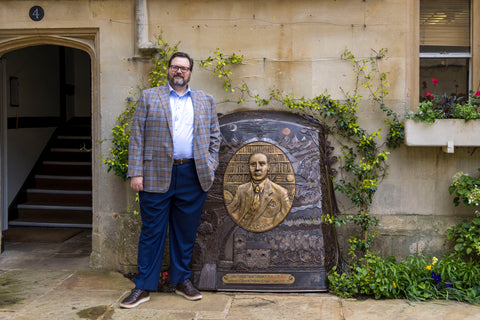
First, I’d like to acknowledge a few people. First, I’d like to give a hearty thanks to Dr. Michael Drout and to Douglas A. Anderson, two scholars who were kind enough to look through this lecture and provide feedback. Their help was invaluable, and indeed, Dr. Drout provided some interesting factoids about Tolkien and his work which I’ve ended up including.
Next, I wish to give a thanks to Utah Valley University, and especially to Dr. Ethan Sproat and Scott Paul—thank you for the invitation, your support, and all the work that went into bringing this together.
To Pembroke College, thank you for your hospitality.
To the Tolkien Lecture Committee for organizing and sustaining these conversations.
To Oxford Town Hall and the Bodleian Library, thank you for hosting us in places that carry so much history and scholarship.
And finally, to my team—thank you for your work, your patience, and your commitment throughout this entire process.
Introduction
In the late 1930s and early 1940s, Professor Tolkien wrote the initial drafts of his essay, “On Fairy-Stories.” The Hobbit was only a couple of years old, and Tolkien hadn’t finished Lord of the Rings yet; in fact, he’d barely started. By the end of 1938 the hobbits had only reached Rivendell, Frodo was still named Bingo Bolger-Baggins, and Aragorn was Trotter, a “wild hobbit” who wore wooden shoes.
Regardless, “On Fairy-Stories” quickly became a foundational text for the genre he was pioneering. Fantasy was not new in 1939. It can be argued that the genre is as old as storytelling. Even the term “fantasy,” in relationship to genre, was not new. George MacDonald is the first to popularize it with his book Phantastes (spelled with a “ph”) in 1858.
However, something different happened with the publication of The Hobbit, and more importantly, The Lord of the Rings. I’d like to speak to that today: the innovations Tolkien made, how these spawned a new subgenre, and why fantasy stories are still relevant today. Consider this a kind of generational retrospective of “On Fairy-Stories,” with an eye toward doing something dangerous: defining what a fantasy story even is.
Why Limitations?
The invitation to lecture here in this prestigious, historic location cannot help but provoke a man to question his own credentials. While I am a reader and lover of these stories, I am not a true scholar of them. That said, I’m encouraged by the fact that Tolkien, in his essay, said something similar about himself—and I do hazard to guess that I’ve spent as much time as anyone in the wilderness that is the outreaches of this genre, wrestling with what portions of it can be brought home and cultivated into stories.
Fantasy can be, at its most simple, defined as the genre where anything can happen. For large stretches of history, it was primarily an oral medium: stories imagined on the spot, then told to fascinate and delight. It is the genre of the fairy-story, the myth, and the tall tale. As I mentioned, it is a wilderness of untamed possibility, where anything can grow; walking those wilds, you will find wonder and awe in abundance, but not really structure.
Indeed, it could be argued that fantasy is antithetical to structure. How do you define or encapsulate the infinite? The half-formed? The inchoate ideas that lie just beyond the horizon, tantalizing, daring us to stretch a little further so that we might catch the briefest glimpse of their majesty among the shifting and obscuring mist?
Yet in order to succeed as a literary genre—to change from stories whimsically imagined, to stories repeated around hearth fires, to stories that fill the pages of novels in a satisfying and profound way, fantasy must adopt structure. We must impose bounds on the boundless. We must stop at some place upon that horizon and explore not the next hill over, but the ones we have already traversed, striving to find the story among the storied ideas.
Fortunately, imaginations are like fractals: they express more and more detail the longer you study them. Slice off a piece of infinity, and that piece itself will be infinite. As authors, we don’t seek to constrain imagination, merely harness it. To this end, I am going to put a few definitions in place.
What Is Fantasy? Three Definitions.
First off, Fantasy is FICTION.
This is the first, and most important rule. Fantasy as I will define it must be imagined as fiction, presented as fiction, and accepted as fiction.
It is not within the scope of this lecture to posit on the nature of religion or deity, but surely we must agree that the Bible, the Koran, and the Upanishads are attempting to do something very different from The Lord of the Rings. A fantasy story might imagine deities, but they are fictional deities, presented without calls to faith or adulation. They can be metaphors or allegories (sorry, professor) for real-world religious traditions, but their context must be fictional. Aslan is not Jesus Christ. Eru Ilúvatar is not Elohim.
This leads us to our first big problem in defining which historical works are fantasies. Is The Odyssey a fantasy work? Did Homer take what he believed was an oral history of actual events, and dramatize them? Did his audience believe these were the actions of gods, or was this all metaphor and entertaining fiction? It gets more difficult, even, with texts like Beowulf or the Epic of Gilgamesh, where we have even less context. What of the fairy-stories that Tolkien so loved? How many of the people telling them believed in those fairies? To them, was the tale of an elf king a historical fiction, with imagined characters but a real-life setting?
As I believe intent is important, I cannot categorize most works existing before the 1800s as being fantasy. I cannot say 100% whether Shakespeare believed the ghost of a dead father would, and could, return to give warning to his princely son. Though I do know that when it came time for the prophecy of Great Birnam Wood moving to high Dunsinane Hill, Shakespeare doesn’t have the trees move there themselves. However, this problem does lead us to our second definition.
Second: Fantasy must be Impossible.
In his essay, Tolkien seeks to define the Fairy-Story, and rejects most common definitions. Fortunately, the great philologist himself was handy with a definition. To him, a fairy-story is a story about the land of fairy, the “Perilous Realm” full of danger and wonder. Fantasy, in turn, is not about a place, but an idea. The idea of the impossible being made, briefly, to seem real.
The dividing line between science fiction and fantasy is a vague one, a contested border with armies camped on either side and winning ground back and forth. Subgenres and (these days) internet trope tags are seized and relinquished like banners. John Clute, in The Encyclopedia of Fantasy Literature, defines fantasy as “a self-coherent narrative. When set in this world, it tells a story which is impossible in the world as we perceive it; when set in an otherworld, that otherworld will be impossible, though stories set there may be possible in its terms.” I like to simplify this to say, “Fantasy is about the impossible, while science fiction is about the plausible.”
This isn’t a perfect definition. Unlike science, which can measure the weight of an atom, we cannot strictly measure words, as they represent ideas—and ideas, as we’ve established, are boundless nuggets of possibility always upon the horizon. Some stories will stubbornly refuse our boxes, and that’s all right, because we have one final definition to help us determine what constitutes fantasy.
Third: Fantasy uses Fantasy Aesthetics
You might find this recursive. What good, you might say, is a definition that contains a reference to itself?
In this final definition, we must accept that fiction is an art, and not a science. How do we tell the Art Nouveau from the Art Deco? Well, we look at it, and measure which aesthetic it is using. Importantly, we look at the artistic movement the artist was part of, and how they viewed their work. The same is true for fantasy literature. Now, mark me here, I’m not saying that fantasy must use trappings like elves, knights, or castles. However, barring an intentional desire to hide subgenre, a fantasy story presents itself as such.
Fantasy leans into, but isn’t limited to, certain emotional experiences. Exploration, a sense of wonder, the visiting of a land where our rules no longer work—and new rules must be understood. It can be horrifying, with the magic a dark and ominous unknown. It can engage the problem-solving parts of our brains by presenting new impossible branches of physics. It can travel to Middle-earth or take you to a pub in London with monsters in the basement. However, it is always challenging the idea of what is real, and what can be real.
Now, you might ask, “What about “INSERT STORY SET IN SPACE WITH FANTASY ELEMENTS.” Is it fantasy, is it science fiction? The answer is yes. It is both. Just like Lord of the Rings is both a fantasy story and a war epic. Just like Narnia is both a fantasy story and a Christian allegory. Just like Mistborn is both a fantasy story and a heist. A story is never just one genre.
Two Pillars of Fantasy
With these three definitions in place—fantasy being fiction, which is impossible, which is presented with intentional fantasy aesthetics—we can finally approach the purpose of this essay. I want to explore what fantasy as a genre looked like before Tolkien, then talk about his innovations in creating my favorite of all fantasy flavors: the epic fantasy.
So first, let us ask: what kinds of stories was fantasy regularly telling before The Hobbit and (more importantly) Lord of the Rings were released?
Variant One: Portal Fantasy
In this section, I’m going to rely upon my own views and experiences with the genre, and my own studies. For the dedicated scholar, I’ll suggest one look to Fara Mendelsohn’s Rhetorics of Fantasy, which offers a different classification system from my own. I do not claim to know more than she does, but I also have relied upon my own definitions for some years now, and find them strong and useful.
By my view, the most common fantasy tale from the 1800s and early 1900s, when this genre first came of age, is the classic portal fantasy. These are stories about a person from the mundane world who finds some gateway, portal, or strange passage into the world of fantasy. They explore it, find it fraught with danger and wonder, and then (hopefully for them) return to the mundane world. The most famous early example is 1865’s “Alice’s Adventures in Wonderland.” It certainly meets our definitions. It is fiction, intended as a tale for children. It is impossible, full of potions and vanishing cats. And, last of all, it paints with the colors of fantastical whimsy.
However, it is not the first of its kind. Tolkien himself, as a youth, was fond of George MacDonald’s Phantastes—though he later found it a little too moralizing. This book, from 1858, is often cited as an inspiration to the 20th century authors.
Early portal fantasies owe a lot to the classic fairytale, a distinct subset of the fairy-story. While the “portal” in them is often more nebulous than an actual gateway—involving a trip into the darkest woods, for example—they have the same hallmarks of what would become Alice’s Adventures, Narnia, and Harry Potter from our modern age. Though many of the most famous portal fantasies are for children, they don’t have to be; in fact, I’d argue that the modern urban fantasy is a variant of the portal fantasy, albeit with some horror elements added in. In these, characters often enter the alternate world not via dream or fairy ring, but via doors in dark alleyways.
The portal fantasy has remained a vibrant, popular pillar of the fantasy genre from its inception, with roots in mythological or religious texts, like Dante’s Inferno or classical Greek descents to the Underworld. They are easy to get into, as they use a character from our world to provide relatable eyes through which to experience the fantastic.
However, there is a second fantasy variant just as old as the portal fantasy—and one that Professor Tolkien himself was quite fond of studying. That is the heroic fantasy.
Variant Two: Heroic Fantasy
Heroic fantasy is that genre popularized by people like H. Rider Haggard, famous for his book King Solomon’s Mines, and William Morris. These were huge influences on Tolkien, to the point that he told his fiancée Edith that he was hoping to produce something like William Morris’s romances "with chunks of poetry in between.” I discovered this genre through Robert E. Howard’s Conan stories, which came a little later.
These are stories with their roots in the heroic epics. Beowulf, dear to Professor Tolkien’s heart, is the ur example in English—though of course, time has lost us even the name of the Beowulf Poet, leaving us with only imagination as to the great scop’s intentions with the poem. A heroic fantasy traces the larger-than-life exploits of a heroic figure facing incredible odds. Normally, the hero explores new lands and defeats foes with sword and muscle in a low-magic setting, where wizards connive and spells are never to be trusted completely.
It can be argued this was the first subgenre of fantasy to actively target a mature audience, as while many early entries—such as the John Carter stories (which are also portal fantasies)—maintain a bombastic pace, there is also a gritty realism to them. They contrast the often surreal fairy-stories, or the whimsical portal fantasies, with grit and even nihilism. People die in brutal ways. The hero is not guaranteed victory; he or she might be larger than life in may ways, but is still often a lone warrior against the might of nations. There is a sense of desperation, fear, and even melancholy to these stories.
One curious aspect to a lot of the early heroic fantasies is their connection to our world. Secondary world fantasies did exist, but were very rare. Haggard’s Allan Quatermain is a man from England. Conan was set in the prehistory of our world, and John Carter was an American sent to Mars. Once Tolkien popularized the secondary world, however, many later heroic fantasies followed suit. Authors like Fritz Lieber, David Gemmell, Michael Moorcock, and a popular modern example—my friend Joe Abercrombie—all take place in secondary worlds.
Tolkien’s Day
When Tolkien sat down and wrote that famous first line of the Hobbit around 1930, heroic fantasy was the environment. Oz, Barsoom, and the pulp magazines like Weird Tales were the dominant forms of fantasy. Haggard and Morris were among Tolkien’s favorites. But all of these books and stories, while excellent, were seen as niche. There wouldn’t be a fully recognized fantasy book on the bestseller lists until almost fifty years later, with the release of Terry Brooks’s The Sword of Shannara. Fantasy was seen as a genre for children or the childlike.
We all know what happened. Tolkien rebuilt and restructured not only fantasy, but the industry as a whole. Publishers sat around scratching their heads as a sequel novel to a children’s book became the most exciting publishing phenomenon since Agatha Christie.
We aren’t here to simply laud Professor Tolkien, however, but to analyze what he did and how it created a third subgenre pillar of fantasy. The pillar we have come to call epic fantasy.
Variant Three: Epic Fantasy
I feel that Tolkien made five key innovations that together created the epic fantasy subgenre—which, to this day, remains a major force in the industry.
Now, to give due consideration to Tolkien’s contemporaries, none of these five innovations were created whole-cloth by him. He was part of a conversation, a dialogue, and as any artist knows, nobody—no matter how brilliant--sits in a room without any influences and creates something powerful.
Tolkien was not the first to do a secondary world fantasy. Though there are some precursors, like Eliza Haywood’s The Adventures of Eovaai (ee-oh-VAY-ee), Princess of Ijaveo (eye-JAH-vee-oh) in 1736, I’m sufficiently convinced that the first true secondary world fantasy is Phantasmion by Sara Coleridge who, way back in 1837, was laying the groundwork for modern fantasy, and deserves every bit of credit for her imaginative and shockingly prescient writing.
Tolkien was not the first to build immersion in a story by including in-world artifacts as ephemera; Dracula, for example, was using in-world journals to tell its story before Tolkien made the Hobbit into a relic discovered and translated to English.
However, the same can be said of Einstein, whose theory of relativity was greatly influenced and accelerated by the work of his contemporaries and forerunners. We do not need to exaggerate and say that Tolkien invented everything ex nihilo or fully formed, like Athena springing from the mythological forehead. It is rather his assemblage of these ideas into a cohesive subgenre that we celebrate.
Innovation One: Sincerity
I have nothing against whimsical fantasy. I enjoy that style of story, and have even written a few myself. However, I feel the first thing Tolkien did was present an unabashedly serious work in what was considered by many an unserious genre.
I grew up as part of Generation X. We are the generation in which nerds were often told we should be ashamed of what we love. While my wonderful parents were encouraging, media and society in general presented nerd culture as childish and cringeworthy. You can see the effects of this in my generation’s humor, commonly seen in recent Marvel or Star Wars films, where sincere moments are often undercut by a quick joke. We Gen-Xers have trouble admitting that we love what we love, and often feel the need to hide or bury sincere moments in media we create. As if to say, “Ha, you didn’t think I was actually serious, did you?”
I find it nothing less than incredible that Tolkien didn’t ever do this. Here was this distinguished professor, a veteran soldier, a scholar of the English language... and he unabashedly created the first epic fantasy story, full of heart, warmth, heroism, and most of all sincerity. There is levity in Lord of the Rings, certainly, but it is the levity of friends relaxing after a difficult phase of their journey. There isn’t a single moment where Tolkien winks at us, and he never acted the least bit ashamed. In fact, he was a staunch defender of, and advocate for, these kinds of stories.
In the early to mid 2000s, J.K. Rowling gave a series of interviews, including one with Time Magazine and another with the Guardian, where she consistently mentioned that she doesn’t like the fantasy genre, and doesn’t read it. One gets the sense, from her tone, that she considers her work above or better than the genre; to the point that she claims she didn’t even realize that Harry Potter was fantasy. The amazing Sir Terry Pratchett has a wonderful counter to her in the form of a 2005 letter he wrote to the Sunday Times, and I wholeheartedly recommend giving it a read.
Regardless, this is attitude J.K. Rowling has is common theme among some authors of our genre; they so desperately want the approval of traditionally serious genres that they feel the need to distance themselves from the rest of us.
Never Tolkien. His characters were authentic, his stories sincere, and his love of them genuine. The world could dismiss the rest of us, but not the stubborn Oxford professor who refused to back down or bow before popular academic trends. This is the first innovation that made Lord of the Rings shine.
Innovation Two: Magic
In “On Fairy-Stories,” Tolkien is insistent that magic must be taken seriously. While a story can be satirical, the magic must not be. I consider Tolkien’s use of magic his second big innovation.
Fantasy magic systems are of personal and artistic interest to me. I am credited with popularizing the terms “hard” and “soft” magic. People often mistake me for preferring hard magic systems, where the rules are concrete and the characters can therefore use their magical skills to problem-solve. However, my actual preference is for stories that know how to best use their tools, whether that tool be a hard magic system, a soft one, or—in the case of Lord of the Rings—both at once.
When I initially started working on this speech, I began with this section. I half imagined that I’d be here today lecturing for an hour exclusively on Tolkien’s use of magic! Though I eventually decided to expand the scope of the essay, this is the ember that started the fire.
Middle-earth is old, older than men, older than even elves. The songs that Ilúvatar sang are one part magic, one part art, one part dream. Rather than delve into the deepest parts of the Legendarium, however, I want to look at the practical use of magic in Lord of the Rings. Not how it works from a lore perspective, but rather how it works on a nuts-and-bolts narrative level.
Magic in early heroic fantasy is largely something to fear, never to be used without danger. (The Palantír comes to mind in Lord of the Rings.) Magic in early portal fantasy was often something of fairy, gifted by gods or fae. A magical weapon, a potion, or other piece of lore. (Note that Galadriel’s gifts in Lothlórien mimic this sort of story.)
While Tolkien was obviously familiar with these uses of magic, and incorporated them, he also did something new. He made some uses of magic approachable. Maybe not understandable, at least not by the hobbits, but neither is magic strictly fearsome. When crossing the Ford of Bruinen, Gandalf and Elrond use magic to cause the swelling river to wash away the Nazgûl. When Old Man Willow uses a somewhat classical fairy-inspired glamor to lure the hobbits to sleep, Tom Bombadil proves his power over the fairy realm in releasing them.
What is most interesting to me in scenes like this is how amicable Gandalf, Tom Bombadil, and Elrond are. Even in Arthurian lore, magic is usually presented as something dangerous. Merlin is mysterious, and sometimes considered an unnatural associate for a good Christan king. He is often presented as half demon, and while he is a force for good, he is also enigmatic and arcane, sometimes written as a wild man from the dark parts of the forest—or, in other words, from the fae realm.
In contrast, Gandalf is a relatable friend to the hobbits. While he is stern at times, it is a realistic, human kind of grouchiness he displays. He gets annoyed, tired, confused—but is also valiant, devoted, and nurturing. Tolkien doesn’t seem to have started with Gandalf being a supernatural being, but a person, relatable and understandable. Eventually, this evolve to him being a Maia, and therefore (like Merlin) a creation from beyond this realm, yet Gandalf remains strikingly human. In Lord of the Rings, Tolkien imagined his angel as not some unknowable being, but a person you’d enjoy sitting down with for a good smoke.
This sets the stage for what became a theme of later epic fantasies: magic in the hands of the protagonists. Magic as a thing to learn about and master. A skill, an art, or even a science. In my lectures on the topic of magic, I make a point about the different effects a hard magic system and a soft magic system can have on a story. Hard magic, which the characters can use as a tool, acts as a reward for learning and practice. Its costs can be weighed and it allows for skill and bravery to be exercised.
Soft magic, conversely, keeps these rules (if there are any) hidden from reader and character, and in so doing creates mystery, wonder, or terror.
We can see Tolkien using both ideas. On one hand, we have Gandalf. Friendly, an ally, but a bit mysterious. When he uses magic, he references a “spell” or the like, but we never are given the rules or methods he employs. Gandalf’s is a soft magic system, though there are hints that if we fully dug into the legendarium we would understand what he does. Indeed, I’ll bet there are many here who could go into the details for us at length!
Tolkien uses Gandalf, and others like Tom Bombadil, to full effect in creating the wonder that is a hallmark of a soft magic system. The hobbits, and to an extent the rest of the mortal fellowship, are shown through Gandalf how vast and deep the world is. Tolkien was, as we all know, a Beowulf scholar; and it is no coincidence that the Hobbit and Beowulf both include a scene involving a thief stealing a golden cup from a dragon’s hoard. Lord of the Rings is the “what if” story of someone who isn’t a traditional hero striking out into a world pulled from Anglo-Saxon myth. To this end, magic and the world at large need to make the hobbits feel metaphorically small, not just literally.
But then, there’s the ring, which is put into the hands of the protagonist. This is Tolkien’s hard magic system. Everyone who has read the book can say exactly what the ring can do, at least in Frodo’s hands. It makes him invisible. But it corrupts him. Cost, benefit. Lord of the Rings gives a tool of the enemy’s own devising to the smallest and the most weak of the fellowship. With it, Frodo escapes Boromir and Sam rescues his master from the Orcs. It is a boon and a curse, for we see first-hand the quantifiable cost as it changes him.
The hard magic of the ring, in contrast to the soft magic of Gandalf, serves a different narrative function. When Gandalf uses his magic, we never know what the cost will be, and we feel wonder and sometimes uncertainty. When someone uses the ring, conversely, we get to see them solve problems, yet they have to weigh the danger of carrying the ring as well.
I don’t think epic fantasy would be what it is today without both the ring and the sense of wonder in Lord of the Rings. It gives us epic scope, while also retaining a personal use of the magic.
Innovation Three: Mythological Roots
Tolkien’s use of mythology has been analyzed by experts far more versed in his oeuvre than I am, so we will touch upon it more lightly than we did the first two points.
I believe one of the strongest innovations Tolkien made was one of extrapolation. He didn’t just tell stories using direct Anglo-Saxon mythological parallels; he crafted for his story unique races inspired by lore. Elves in Tolkien are not elves seen anywhere in mythology. Certainly, there are hints of inspiration, but they are his own creation. Likewise, Orcs, Dwarves, and Hobbits each challenge traditional fairy-story conventions. Elves might be aloof in Tolkien, but they aren’t cruel. Dwarves do enjoy mining for gold, but they also have a full society and are great builders. Orcs might be fearsome creatures of night, but they’re also fearsome warriors. They are very much not the twisted trickster fae that goblins were in similar tales.
Tolkien didn’t just mimic, he innovated. Though he began by trying to make his stories into legends that would fit with early medieval history, he eventually moved beyond this. Middle-earth isn’t the generic “medieval-land” that some later works sometimes used, as if their stories were set in a renaissance fair melding cultures and time periods.
I didn’t realize this before starting work on this essay, but it seems that the entire concept of a Dark Lord was wholly invented by Tolkien. While there are evil forces in books before, the idea of a demonic figure like Sauron as a direct antagonist to an adventure story seems wholly Tolkien’s.
Regardless, the point here is important. Middle-earth has a profoundly strong aesthetic built on solid historical roots, and used deliberately and consistently.
Innovation Four: Stakes
Tolkien, like his colleague C.S. Lewis, was not afraid of putting world-ending stakes in his stories. This was to become a key component to epic fantasy as Tolkien created it. While not all stories in this subgenre need to put the entire world in danger, this level of danger is commonly used as a way to distinguish epic fantasy from heroic fantasy, which tends to focus on more personal stakes like revenge.
Lord of the Rings isn’t just about the potential fall of a kingdom. It’s about the potential fall of the world. The Silmarillion details threats to existence itself. Lord of the Rings is also, on a more abstract level, a battle between philosophies. Which lord will you follow? The honor and virtue of Aragorn or the corruption and destruction of Sauron? For most people, it’s a given—but Tolkien, again, manages to make these stakes personal.
This is where Gollum is key. My mother is an accountant, and loves accountant sorts of things. She’s here today, by the way. Fantasy books aren’t her staple form of entertainment, but we (her children) dragged her to the Lord of the Rings films anyway. She really got into them, to the point that she was eager to join us for the third film.
It wasn’t the battles that interested her, the political machinations, or even the story of Frodo and the ring. She said, and I remember it distinctly, “I need to find out if little Sméagol will decide to be good or not.” Stakes aren’t enough to make a story work; it must be stakes mixed with a personal relationship with the characters living them.
A story is only as thrilling as our worry for the people in it, and a magic is only as intriguing as our curiosity about how it affects people we love. Gollum is, in this, one of the most important people in the whole story—because he let us see the conflict between honor and greed on an individual level. Will be become the person Frodo sees in him, or will be become the person the ring wants? Likewise, the stakes of a world ending only work because we care, and we cry, and we hurt as Sam carries Frodo up the mountain.
Epic fantasy is, then, a conundrum. It is a story where often the entire world is threatened, but we can’t care about that as much as we care about a gardener who just wants to go home. As stated by folklorist Jack Zipes, “In fantasy, the little person is raised to the position of God.”
Innovation Five: Immersion
I’ve spent years searching for the first completely secondary world fantasy. For a while, I thought Lord Dunsany or George MacDonald might have it, but I—with thanks to others online who popularized it—now believe it to be Phantasmion.
Still, having made study of some of these early fantasies, I find them engaging and interesting—but not immersive. Phantasmion reads like something out of One Thousand and One Nights. It has fantastical lands with interesting names, but it doesn’t seek to persuade us they’re real—more, they are presented as whimsical locations not-quite-like-our-own. Many of the pre-Tolkien secondary world fantasies read this way; like a stroll through a portal fantasy, merely without the portal.
We can all agree that Middle-earth is different. It reads not as a whimsical adventure and more a serious historical record from a world that never actually existed. Part of this is the use of ephemera; the first thing you see when opening the Hobbit, for example, is a map—not just any map, the exact map used in the book, by the characters. (This is one of the quibbles I had with the genre in my early days of my reading; too many included a map merely because it was expected, with no reference to how or where this piece of arcana might have been used or obtained. It’s obviously not strictly necessary to have the map be an in-world artifact, but why not do so and let it build immersion?)
Tolkien was painstaking in his efforts to make his work exude authenticity. There and Back Again and the Red Book of Westmarch, the manuscripts by Bilbo, Frodo, and Sam that Tolkien purportedly translated and adapted, give us a translation buffer that in fantasy we still use today. This “Tolkien translated old manuscripts” idea isn’t merely a fun affectation, it’s necessary to give us a sense of plausibility for the text. Language is inherently anachronistic; too many of our words are obtained from deeply Earth-centric sources.
Immersion depends, in part, on us being willing to suspend our disbelief and dismiss our questions. Tolkien’s work in creating authenticity gives us that permission to accept the work, for a time, as real. To look, briefly, at how this works, let’s talk about why it helps so much to imagine the books in translation from some fantastical tongue.
This issue manifests most obviously in poems, songs, and puns. If a character cracks a joke in a fantasy book, and that joke depends on wordplay, are we to imagine that wordplay worked in their language? If a poem is given, how can it maintain meter in English? The immersion-sustaining answer is that these things were filtered through a master translator in Tolkien, who created similar constructions in English that would convey the ideas that the characters were using. Sam’s name is not Sam, if you didn’t know, but Banazîr—in Middle-earth, the name Banazîr evokes a rustic, homey feeling. In order to give us that same feeling, Tolkien adapted the name to something similar in English.
You might say that we’re overthinking this. If so, might I remind you that we regularly write thousand-page novels about wizards. Overthinking things is the job. Moreover, word choice feeling fantastical is an issue for some readers; they come and ask me questions regularly. When I used the term “hat trick” in Mistborn, was I implying they have the same sports that we do? The word “coach,” as in for a carriage, comes from the name of Hungarian town. If I use that in a fantasy world, does it imply the existence of Hungary? While some readers treat these as amusing gotchas, for others, the questions are sincere—because immersion is one of the key reasons people explore fantasy. It is a good unto itself, allowing us to visit another place, and accept it as wholly authentic while we gain other emotions from that experience, such as sense of exploration and adventure.
Our world is largely explored, and space—though exciting—is beyond our reach. Yet humans want to trailblaze, to set foot in a place never before seen. They want to come to love characters, and treat them as real, and immersion into a world helps that believability. People yearn for the sincerity that is our first point, and Tolkien reinforced it by being exhaustingly particular about his sense of realism.
He was not the first to use ephemera, like his maps or frame stories of original texts. He was not the first to create a secondary world. However, he was the first to take it this seriously, and the reason we continue to love his creations today is because of that attention to detail. The Lord of the Rings wasn’t just a fantastic book series, it was a revolutionary reimagining of what stories could be. Tolkien created, from a fusion of many previous stories, something new. Pounded and forged like the rings themselves, created from ideas made alloy, given the artistry and care that only he could.
Tolkien gave us epic fantasy.
And I worry that, at first, we didn’t quite understand how to use it.
What Not to Learn from Tolkien
Early in my career, I’d occasionally write an editorial on my blog relating to the fantasy genre. That was when I wrote the very first proto-version of what would become this lecture today; at the very least, this lecture consumed the best vittles of that essay, though it left the bulk of the half-formed ideas to the vultures. My original essay had a title that drew a lot of attention, more than I’d expected, and was my first experience with creating clickbait.
To explain, let me talk a little more about the history of fantasy. If there’s an area of the history of the fantasy genre where I’m approaching a scholarly level of experience, it’s those first bestseller years beginning in the seventies and ending in the late nineties. Let us call it the post-Tolkien boom. Its start was the day when Professor Tolkien passed away. Its end occurred at the publication of Harry Potter. 1973–1997, roughly twenty-five years when epic fantasy emerged to become the dominant form of speculative fiction. This is when I discovered books, fell in love with reading, and determined to become an author myself.
During these years, science fiction took a backseat to fantasy for the first time in history. This correlates, and likely in a meaningful way, with the rise of the hardcover novel and the steady decline in sales of the pulp magazine. Science fiction has often been a stronger medium in the short form, but when it came to the long form (and the really long form), fantasy, with its rich mythologies, intriguing political conflicts, and immersive worlds, was king. Or emperor. Or dark lord. Whichever you prefer.
I remember well the period just after the post-Tolkien boom. I tried to publish in the early 2000s, a difficult time to try to sell an epic. Many of our readers were jumping to YA fantasy—which had always existed, but had rarely been distinguished from what we now call middle grade fantasy. Next, they jumped to urban fantasy, as Twilight gave it a resurgence.
The masters of epic fantasy—Martin, Jordan, and Hobb—still sold very well, but had been established in the boom period. And all three had innovated away from the Tolkien style quite quickly. Martin had gone grimdark, melding in heroic fantasy aesthetics (like low magic, pessimism, and brutal deaths) with epic fantasy worldbuilding. Jordan had turned away from the quest fantasy of his first three books, exploring deep political intrigue narratives and an enormous cast. Hobb had adopted a different tack from Martin, taking the personal, single-viewpoint aspect of heroic fantasy (rather than the grim aesthetics) and applying them to an expansive world with a hard magic system.
In 2000, it would be a good decade before Game of Thrones’s premiere would skyrocket George to superstardom, and had been half a decade or more since he, Hobb, and Jordan had established themselves. During this dry spell, epic fantasy struggled to find new voices for the first time in decades.
Books were being published, but weren’t hitting the market as previous ones had. The Fifth Sorceress is the highest-profile flop among these, but there were numerous others. Stephen Erikson is the biggest voice from this period, but even he had difficulty in the market for his first few books. I think a lot of this was due to one fundamental problem: that the genre had spent too long in Tolkien’s shadow, and the publishers and newer authors hadn’t yet learned what Jordan, Martin, and Hobb had. That we could only lean on Tolkien for so long.
My early essay, the one with the clickbait title I referred to at the start of this section, was called “How Tolkien Ruined Fantasy.” My central thesis was this: Tolkien was so far ahead of his time, so brilliant in his execution, that nobody quite knew how to follow him up. Many followed his model too closely.
I don’t blame these authors; I think many of them are fantastic writers, and I’m glad they’re part of our tradition. However, this continued too long, and the genre as a whole didn’t learn the lessons of Tolkien’s five innovations—most specifically the point relating to immersion. Instead of drawing upon mythological roots to create a sincere and original work, publishing learned that a story with elves, dwarves, and a quest for a magical object was how you write epic fantasy.
The problem with this only became manifest in the late nineties, when readers started to experience a concerning affliction. Many of them talked to me about their experiences when I was first publishing—they’d say that they fell slowly out of love with fantasy, because it was no longer giving them the sense of wonder it used to.
In “On Fairy-Stories,” Tolkien talks about three key emotions that come from reading the fantastical: Recovery, Escape, and Consolation. He talks at length in interesting ways about these ideas, and so of course I encourage you to read the essay itself. In short, one core idea of these three is that these stories help us see the world anew. To recover our view of reality, and the inherent wonder in it.
I agree with this idea, though I believe that one key evolution that fantasy made beyond fairy stories is that in fantasy, epic fantasy in particular, we are able to engage the parts of our minds that love to explore something new. And I feel, for a while in fantasy, people weren’t getting that emotion because a lot of the worlds felt the same, the stories repetitive.
We, as a genre, got over this eventually. We learned there is more to learning from Tolkien than merely imitating him. I hope we can continue to learn these lessons. Now, do not mark me as criticizing what anyone wants to write or read; this is a wide-open genre, the most open that any can be. There is plenty of room for books with classical, Tolkien-inspired worlds. It’s merely important that we offer a variety of places to explore, from a variety of diverse roots and narrative traditions, so that we preserve that emotion of exploration and innovation. Otherwise, our readers will look elsewhere for that.
Conclusion: Why Fantasy
As we approach the end of my lecture, I want to move on from Tolkien himself and speak further about the genre he inspired. I remember a day, early in my career, where I was doing a signing at a Costco of all places. Though traditionally not a bookstore, the publisher set up a signing there anyway, and I was happy to go wherever people wanted me.
I signed a book for a young woman who was extremely excited, and as she moved off, her mother leaned in. She said to me something to the effect of, “No offense, but is there any way to get her to read something other than this fantasy crap?”
It is a sentiment I get, now and then. I’ve been asked it by befuddled journalists, buy well-meaning spouses. I got asked it in Dubai by an author of “serious” works who—when I told him that I considered fantasy a serious genre itself—laughed dismissively with the most snide expression I’ve ever been given by a colleague.
I get it from reviewers, interviewers, and critics. Two simple words.
Why fantasy? Why do people love this genre so much? Why does it get its hooks in us, inspire us, stay with us? It’s been a hundred years, almost, since Tolkien wrote his famous line about a Hobbit in a hole. Why are we still celebrating what he created with such lively enthusiasm?
It seems at times, despite all the strides we’ve made, that the world in general is as dismissive of us as it was when Tolkien took it upon himself to write “On Fairy-Stories” in part to defend the genre.
My first answer to this is simple: Why art at all? Why Starry Night? Why Clair De Lune? Can’t a thing simply be beautiful, and that is the reason?
Still, I strive for something more, though I know I cannot answer their question, not fully. Because I can’t speak for a genre, or for art itself. In the end, all I can do is attempt to explain, in the smallest part, why I love fantasy.
When I was young, I thought that any given item or person in my life must be defined specifically, and quantifiably, as to it nature. A fantasy book was one with dragons or wizards, a mystery book was one with a detective, and a serious book was one where everyone was sad.
As a person ages, I like to think they understand that definitions, like people, are fuzzy things, resisting attempts to lock them down. Words, like swords, get worn down over time, the edges resharpened until their shape sometimes only resembles the original forged creation.
In this, I confess the futility of even this essay, which tries so hard to describe fantasy. I like my definitions; I find them useful. I suspect they too will erode, however, and despite my best efforts, they don’t fully explain the why of fantasy.
The truth is, everything has a little fantasy in it. Being inside another person’s head, thinking their thoughts, is impossible, like my definition. Telepathy is fantasy. Yet, that is what books do for us—let us think the thoughts of other people, even if they have been dead for thousands of years.
Imagining the world as different from the way it is now is, after a fashion, a fiction. We live in the real world, as it exists, no matter how much we dream of a different one. And yet, we dream anyway. Because if the world is to change, if tomorrow is going to be a better version of today, that starts with imagination.
In the books I read as a young man, same as the books I read today, I learn about the world. More importantly, I learn about people—how they feel, think, dream, and love. Fantasy isn’t about the past, no more than science fiction is about the future. These books are about learning the minds and hearts of other people. Moreover, fantasy novels are about challenging and improving the reader’s imagination.
And so these books provide two simple goods we could desperately use more of today. Empathy. And hope.
Why fantasy? Because every good thing in the world starts as a fantasy, at some point. Then we dream it into reality. Fantasy is the genre of the impossible, I still insist.
But the people it inspires are exquisitely real.